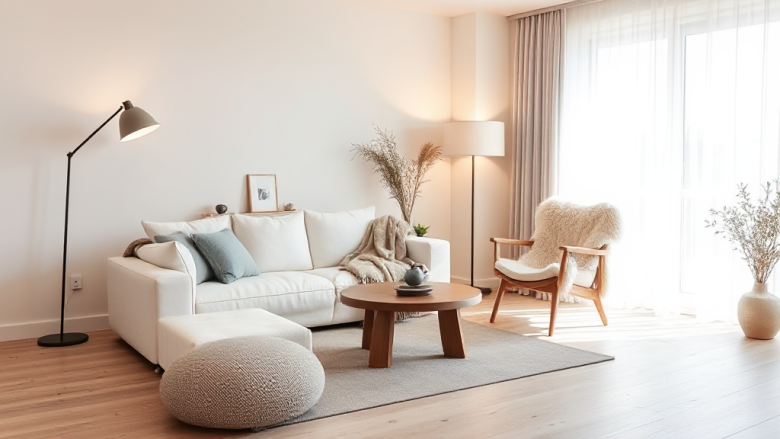
There’s a particular feeling you get when you walk into a Scandinavian interior. The air seems lighter. The room feels calmer, more open, and somehow less demanding. Nothing shouts for attention, yet the space doesn’t feel empty or cold. It’s a balance that looks effortless and is, in truth, the result of a handful of deliberate decisions repeated over and over. If you’ve ever tried to recreate that look and ended up with something that felt more like a showroom than a home, the problem usually isn’t your taste. It’s that you’re missing the underlying logic.
This is everything you need to know about Scandinavian interiors in one place: the light, the color, the materials, the function, and the quiet emotional layer that ties them together. The good news is that you don’t need a full renovation to get there. Most of what makes these rooms work is portable, affordable, and surprisingly practical.
Start With Light, Because Everything Else Depends On It
Scandinavia sits far north, and for large parts of the year the sun is either scarce or low in the sky. That single geographic fact explains more about the region’s design than any style trend. When daylight is precious, you don’t block it, you don’t compete with it, and you don’t waste it. The whole aesthetic is built around maximizing whatever natural light finds its way in.
In practice, this means windows are treated as the main event. Curtains are light, often sheer, and frequently pushed to the sides during the day. Heavy drapery is reserved for bedrooms where darkness actually matters. Furniture is kept low so it doesn’t interrupt the line of sight from the window into the room. Mirrors are placed where they can bounce light deeper into a space, usually opposite a window rather than next to it.
Artificial light follows the same logic. You won’t find one harsh ceiling fixture doing all the work. Instead, light is layered: a floor lamp near a reading chair, a small table lamp on a sideboard, a pendant over the dining table, maybe a candle or two on a windowsill. The goal is pools of warm light at different heights, not an even wash from above. Bulbs tend to sit in the warm range, around 2700K, because cool white light kills the coziness instantly.
If you take one thing from this section, make it this: fix your lighting before you buy anything else. A room with good light and mediocre furniture will feel better than a room with beautiful furniture under a single fluorescent panel.
Color: A Restrained Palette That Isn’t Boring
The stereotype is white walls, white floors, white everything. That’s not wrong, but it’s incomplete. Scandinavian color is less about white specifically and more about restraint. The palette is narrow and consistent, which is what creates the calm. When every surface relates to every other surface, your eye stops working so hard.
The base is usually a soft, warm neutral. Think chalk white, pale greige, oatmeal, or a very light grey with a hint of warmth rather than blue. Pure stark white can read as clinical, especially in rooms with limited daylight, so most designers lean slightly toward cream or bone. Floors are often pale wood, which brings natural warmth back into the equation.
Against that base, color arrives in small, intentional doses. A muted sage green on a single wall. A dusty blue sofa. Terracotta in a ceramic vase. Ochre in a cushion. The trick is that these accents are desaturated, as if seen through a thin fog. Nothing is neon, nothing is primary, and nothing fights the light. You might use two or three accent colors in a room and repeat each of them once or twice so they feel deliberate rather than random.
Black does appear, but sparingly and almost always as a graphic line: a thin metal frame, a lamp base, a picture frame, the legs of a chair. It anchors the softness without darkening the mood. Used well, one black element in a pale room reads as confidence, not contrast for its own sake.
A practical takeaway: pick your base neutral, then choose exactly two accent colors and limit yourself to those for the whole room. If you’re tempted to add a third, resist. The restraint is the point.
Materials: Natural, Honest, and Meant to Age
Scandinavian interiors lean hard on natural materials, and not just for looks. Wood, wool, linen, leather, stone, and clay all have texture and variation that make a room feel alive. They also age in ways that add character instead of looking worn out. A pale oak table that picks up a few marks over the years is doing exactly what it should.
Wood is the backbone. Light woods like oak, ash, and birch dominate because they reflect light rather than absorb it. Darker woods show up as accents or in older pieces, but the overall tone stays bright. You’ll see wood left fairly raw, with a matte oil finish rather than a high-gloss lacquer, so the grain stays visible.
Textiles soften all that wood and add the tactile layer that makes a room feel warm. Wool throws, linen curtains, cotton cushions, a chunky knit blanket over the arm of a sofa. These aren’t decorative extras; they’re what stop a pale room from feeling austere. Sheepskin is a classic for a reason, draped over a chair or placed on the floor beside a bed.
Then there’s the mix of old and new. A modern sofa next to a flea-market sideboard. A sleek pendant above a weathered dining table. This layering keeps a room from looking like a catalog page and gives it a sense of history. You don’t need to buy vintage, but one or two pieces with visible age do a lot of work.
What you won’t see much of: glossy finishes, heavy patterns, ornate carving, or materials that pretend to be something they’re not. Faux wood grain and plastic pretending to be stone undermine the whole approach. Honest materials, even inexpensive ones, hold up better.
Function First, Beauty Follows
Scandinavian design has roots in mid-century thinking that put everyday usability ahead of decoration. The idea is simple: a room should work well before it looks good, and if it works well, it usually will look good. This is why so much of the furniture is clean-lined, sturdy, and free of unnecessary detail.
Storage is a big part of this. Clutter destroys the calm faster than any color mistake, so Scandinavian homes tend to have smart, built-in solutions: benches with hidden compartments, sideboards that close, shelves that display a few chosen objects rather than everything you own. The principle is that every item needs a home, and surfaces stay mostly clear.
Furniture is scaled to the room. Nothing is oversized for the sake of drama. A sofa sits low and long rather than tall and puffy. Chairs have slim frames so you can see through them. Legs are often tapered or splayed, which lifts pieces off the floor and makes a small room feel bigger. This isn’t a stylistic quirk; it’s a response to compact urban apartments where every centimeter counts.
Durability matters too. Pieces are chosen to last, not to be replaced every few years. That’s partly practical and partly cultural. Buying well once and keeping something for decades fits the whole ethos, and it’s a big reason the look has stayed relevant for so long.
Hygge: The Feeling That Holds It All Together
You can get every element right and still end up with a room that feels flat. What’s usually missing is hygge, the Danish concept that roughly translates to a feeling of cozy contentment. It’s not a style you can buy, but you can design for it.
Hygge comes from warmth, softness, and a sense of care. It’s a candle on the dinner table. It’s a throw blanket within reach of the sofa. It’s a mug you actually like holding. It’s the difference between a room that’s styled and a room that’s lived in. Scandinavian interiors look effortless because they’re designed around real moments: reading, eating, talking, resting.
Practically, this means layering textures, keeping lighting low and warm in the evening, and leaving a little imperfection in place. A stack of books. A half-finished puzzle. A plant that’s clearly been there a while. These small signals tell your brain that this is a place to relax, not a place to perform.
How to Get the Look Without a Renovation
Most people can’t rip out walls or refinish floors, and you don’t need to. The core elements of Scandinavian design are portable. You can shift the feeling of a room with a few targeted changes over a weekend.
Start with light. Swap heavy curtains for lighter ones, move furniture away from windows, and add a mirror where it can catch daylight. Replace any cool-white bulbs with warm ones, and add two or three small lamps at different heights instead of relying on one overhead fixture. This single step changes more than any purchase.
Next, declutter and edit. Clear surfaces, find homes for loose items, and choose a few objects to display rather than many. Then bring in texture: a wool throw, a linen cushion, a rug in a natural fiber. Finally, add one or two muted accent colors and repeat them once each. If you can, introduce a single vintage or aged piece to break up the newness.
That’s it. No demolition, no designer budget, no perfect floor plan. Just light, restraint, natural materials, and a bit of warmth. The look isn’t about owning the right things; it’s about making a series of small, consistent choices that let a room breathe.
Frequently Asked Questions
Is Scandinavian design the same as minimalism?
They overlap, but they’re not identical. Minimalism often strips a room down to as little as possible and can feel austere. Scandinavian design is warmer and more forgiving. It still favors clean lines and clear surfaces, but it always brings in texture, natural materials, and a sense of comfort. The goal isn’t emptiness; it’s calm.
Can I do Scandinavian style in a small or dark apartment?
Yes, and it’s arguably where the style works best. Pale walls, light wood, low furniture, and layered lighting are all strategies for making small or dark rooms feel bigger and brighter. Keep the palette narrow, avoid heavy furniture, and use mirrors to move light around. You don’t need large windows to get the effect.
Do I have to use white walls?
No. White is common because it reflects light, but warm off-whites, pale greys, soft beiges, and even muted greens or blues work well. The key is keeping the tone light and the palette restrained. If you choose a color, keep the trim and ceiling a related neutral so the room stays cohesive.
What’s the biggest mistake people make with this style?
Making it too cold. When people focus only on white walls and clean lines, they end up with a space that feels sterile. The fix is almost always texture and light: wool, linen, wood, sheepskin, warm bulbs, and a few lived-in details. Scandinavian design is cozy at heart, and if your room doesn’t feel good to sit in, something’s missing.